How Search Engine Optimization Works for Small Business
If you own a business, you’ve likely been told a dozen times that you "need better SEO." But between algorithm updates, keyword research, and technical jargon, understanding how search engine optimization works and how it drives revenue isn’t easy.
At its core, Search Engine Optimization (SEO) is the practice of structuring your website so search engines like Google understand your services and rank your business when potential clients search for what you offer.
Here is a straightforward look at how search algorithms evaluate websites today and how smart SEO strategies build long-term online visibility.
How Search Algorithms Evaluate Your Website (Answer: Spiders)
Search engines exist to give searchers the most accurate, high-quality answer to their query as quickly as possible.
To organize the web, search engines operate through three continuous steps:
Crawling: Search engine bots (often called "spiders") scan website pages across the internet to discover new content, updated text, and media.
Indexing: The search engine analyzes and archives that content in a massive global registry.
Ranking: When a user types a query, the algorithm evaluates indexed pages to deliver the most authoritative, relevant results at the top.
The 3 Pillars of a High-Ranking Website
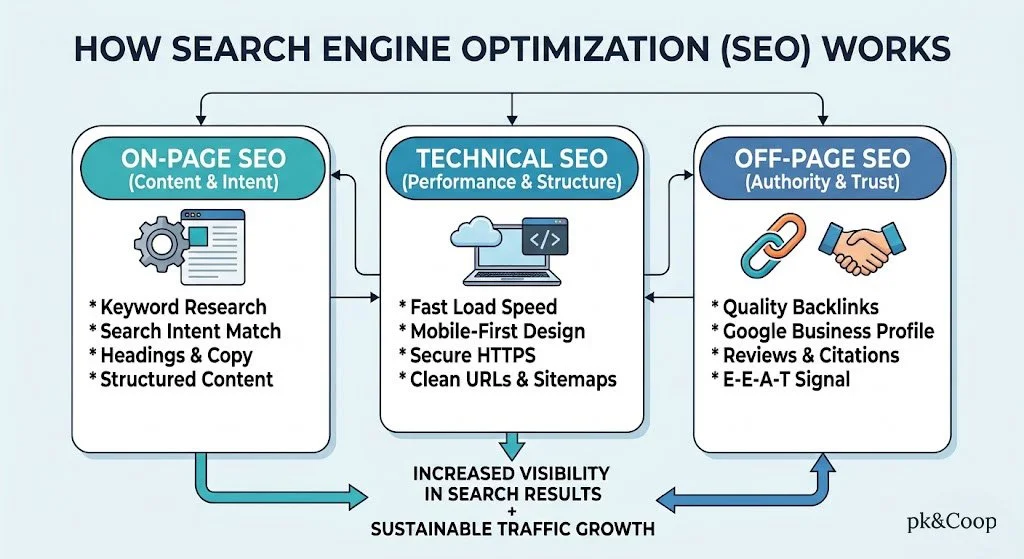
Modern SEO isn't just about dropping keywords onto a page. Sustainable rankings rely on three distinct components working together:
1. On-Page SEO (Content & Intent)
This covers everything on your public web pages. It involves creating clear, authoritative copy that matches user search intent, organizing headings strategically, and providing direct answers to the questions your clients are asking.
2. Technical SEO (Performance & Structure)
Technical SEO ensures search engine crawlers can read and index your site without roadblocks. This includes fast page load speeds, seamless mobile responsiveness, clean URL structures, and secure HTTPS protocols.
3. Off-Page SEO (Authority & Trust)
Off-Page SEO reflects your website's reputation across the web. In addition to quality backlinks, a Google Business profile, and reviews , modern search engines evaluate off-page authority using Google’s E-E-A-T framework:
Experience: Demonstrating first-hand, real-world knowledge in your industry.
Expertise: Sharing clear, accurate, and insightful information.
Authoritativeness: Earning quality backlinks from reputable websites and maintaining an active Google Business Profile.
Trustworthiness: Securing positive client reviews, clear contact information, and transparent business practices.
Why Modern SEO Focuses on Search Intent
Years ago, websites attempted to game search engines with "keyword stuffing,” the practice of blindly repeating search terms in invisible or awkward text blocks.
That no longer flies (if it ever did). Today’s algorithms prioritize search intent and semantic context. Search engines look beyond simple phrase matching to evaluate whether a page genuinely solves the user's problem. Demonstrating real-world expertise, clear structure, and user-focused answers matters far more than arbitrary keyword counts.
SEO in the Age of Google AI Overviews
With AI overviews appearing at the top of search results, the way people discover businesses is evolving. But here is what hasn't changed: AI models rely entirely on indexed, well-structured website content. To be cited in AI summaries and traditional search results alike, your website needs clear formatting, fast loading speeds, and unique, authoritative answers that AI tools can easily parse and trust. Modern SEO ensures your business stays visible whether a client clicks a link or reads an AI snippet.
Wondering how search engine optimization works for you? Here’s a checklist:
Claim & Verify Google Business Profile: Essential for showing up in local searches and Google Maps packs.
Establish Heading Hierarchy: Use a single clear H1 title per page, followed by logical H2 subheadings.
Customize Meta Snippets: Write unique SEO titles and descriptions designed to capture clicks in search results.
Add Descriptive Image Alt Text: Assist search engine crawlers in identifying your visual content while improving screen-reader accessibility.
Prioritize Mobile Performance: Ensure your website loads quickly and functions effortlessly on mobile cellular connections.
Ready to build an SEO-Optimized website?
SEO isn't a one-time add-on—it's a foundational element of effective website design. At pk&Coop, every custom Squarespace website we build is crafted with clean technical SEO, mobile-first performance, and search-optimized structure from day one.
Ready to grow your online search presence? Explore our services to see how we build high-performing websites, or get in touch with us today to discuss your project!